


MI Sunrise V4500 Series
Designed for replacements, MI Sunrise Series vinyl windows are durable, energy-efficient, and stylish, with various grid, glass, and color options.

ProVia Aeris™
ProVia’s Aeris™ wood-clad windows feature durable vinyl frames that offer strength, moisture resistance, and excellent fire performance.

ProVia Endure™
ProVia’s Endure vinyl windows combine exceptional energy efficiency with beautiful design and customizable options for year-round comfort.

ProVia Aspect™
ProVia’s Aspect vinyl windows offer superior durability and energy efficiency, featuring a high-tech glass package that reduces heat loss and condensation.

Weather Shield Contemporary Collection
Enjoy wider views, refined hardware, and endless options with the next-generation Contemporary Collection windows—modern design at its best.

Weather Shield Premium Series
Premium Series windows offer a unique take on a classic design, combining strong ventilation, energy efficiency, and easy operation.

Weather Shield Signature Series
Built with Tricore™ Frame Technology, Signature Series windows offer top energy efficiency and customizable finishes to suit your home.
We Can Provide Any Type of Window You Need
Find the Right Window Style for Every Room in Your Home
At The Door Store, our mission is simple: give you the exact windows you want, install them correctly, and charge a fair price.
That sounds straightforward, but choosing replacement windows can get complicated quickly. Double-hung or casement? Picture or slider? Would a bay window work better in the living room? What makes the most sense for a bathroom, basement, or kitchen?
The best window style depends on more than appearance. Ventilation, ease of cleaning, available wall space, natural light, views, and the architectural style of your home all matter.
Below are some of the most popular replacement window styles we install throughout Chicago’s Western Suburbs. If you do not see exactly what you are looking for, do not worry. There is a very good chance we carry it, and we can help you explore additional configurations and custom options.
Compare Window Styles
If you are narrowing down your options, this table gives you a quick look at how the most common window styles compare.
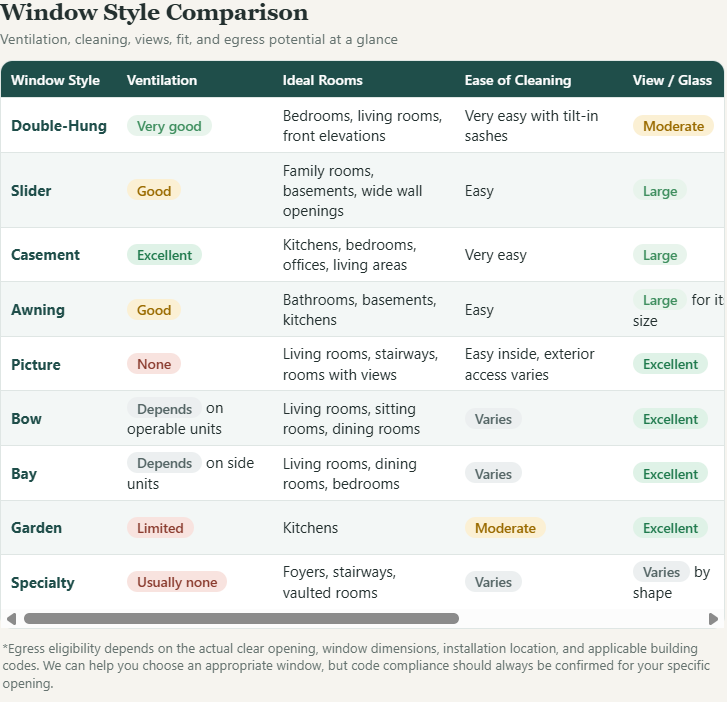
Double-Hung Windows
Double-hung windows offer a classic design, plenty of versatility, and a familiar look that works on many homes throughout the western suburbs.
Both the top and bottom sashes move, which gives you more control over ventilation. On many models, the sashes also tilt inward or remove for easier cleaning from inside the house.
That combination makes double-hung windows particularly useful in:
- Bedrooms
- Living rooms
- Dining rooms
- Second-story rooms
- Traditional front elevations
Visually, double-hung windows have balanced vertical proportions that complement Colonial, Craftsman, Cape Cod, and other traditional architecture. They also adapt well to transitional homes where you want a classic look without making the exterior feel dated.
When appropriately sized, certain double-hung windows may also be able to meet bedroom egress requirements.
Energy-efficient designs use weatherstripping and insulated glazing to reduce drafts and heat transfer.
Energy Efficiency: Double-hung windows typically have U-factors ranging from 0.27 to 0.30, depending on the manufacturer, glass package, and configuration.
Technical Specifications:
- Materials: Vinyl, Aluminum-Clad
- Dimensions: Custom sizes available
- Performance Ratings: U-factor 0.27-0.30, SHGC 0.20-0.30
Slider Windows
Sliding windows are a practical way to fill a wide opening without dividing the wall into multiple separate windows. One or more sashes glide horizontally along a track, creating simple operation and a broad view.
Their low-profile design makes sliders especially attractive in rooms where vertical height is limited but wall width is available.
Good locations include:
- Family rooms
- Finished basements
- Bedrooms
- Ranch-style homes
- Rooms facing patios or backyards
Because the sash does not swing inward or outward, slider windows also work well near walkways, decks, and other areas where a projecting window could get in the way.
The wide proportions fit naturally with ranch, mid-century, contemporary, and transitional architecture.
Energy Efficiency: Slider windows typically offer U-factors between 0.25 and 0.29.
Technical Specifications:
- Materials: Vinyl, Aluminum-Clad
- Dimensions: Custom sizes available
- Performance Ratings: U-factor 0.25-0.29, SHGC 0.19-0.30
Casement Windows
Casement windows are one of the best choices when you want ventilation and a clear view at the same time.
These windows hinge along one side and crank outward. Since the sash can open close to 90 degrees on many models, casements can catch passing breezes and direct fresh air into the room.
That makes them especially useful in:
- Kitchens
- Home offices
- Bedrooms
- Living rooms
- Areas overlooking landscaping or outdoor spaces
Casements also work well over counters or sinks because the crank makes them easier to operate than windows that require you to lift a sash.
When closed, the sash presses firmly against the frame. That compression-style seal is one reason casement windows are known for strong energy efficiency.
Their narrow frames and broad glass area work equally well with traditional and modern architecture.
When properly sized, casement windows can also be a strong egress option because of the large clear opening they can provide.
Energy Efficiency: Casement windows typically have U-factors between 0.17 and 0.28.
Technical Specifications:
- Materials: Vinyl, Aluminum-Clad
- Dimensions: Custom sizes available
- Performance Ratings: U-factor 0.17-0.28, SHGC 0.27-0.30
Awning Windows
Awning windows share many of the benefits of casements, but they hinge at the top and open outward from the bottom.
That creates a small canopy effect over the opening. During a light rain, you can often keep the window cracked open without allowing water to fall directly inside.
Awning windows work particularly well in:
- Bathrooms
- Basements
- Laundry rooms
- Kitchens
- Above or below picture windows
Their compact shape makes them useful higher on a wall where you want daylight and ventilation but also want to preserve privacy.
They are also a smart companion to fixed glass. For example, a large picture window paired with a smaller awning window can give you both an open view and fresh air.
Energy Efficiency: Awning windows generally have U-factors ranging from 0.25 to 0.29.
Technical Specifications:
- Materials: Vinyl, Aluminum-Clad
- Dimensions: Custom sizes available
- Performance Ratings: U-factor 0.25-0.29, SHGC 0.20-0.30
Picture Windows
Picture windows are all about light and the view.
Because they are fixed and do not open, there are no tracks, hinges, or operating sashes to interrupt the glass area. That creates clean sightlines and makes picture windows an excellent choice when the scenery outside deserves to become part of the room.
They work especially well in:
- Living rooms
- Great rooms
- Stair landings
- Dining areas
- Rooms overlooking yards or gardens
Picture windows also pair beautifully with operable windows. A large fixed center unit can be flanked by casements, double-hung windows, or awnings to combine a panoramic view with ventilation.
Since there are no moving components, fixed windows also tend to seal very tightly.
Energy Efficiency: Picture windows typically have U-factors between 0.20 and 0.25.
Technical Specifications:
- Materials: Vinyl, Aluminum-Clad
- Dimensions: Custom sizes available
- Performance Ratings: U-factor 0.20-0.25, SHGC 0.18-0.25
Bow Windows
Bow windows extend outward from the exterior wall in a gradual curve, usually using four or more window units to create the shape.
The effect is softer than a bay window and can bring an impressive amount of natural light into the room. From inside, a bow window can make a space feel wider and more open. From outside, it adds dimension and architectural interest.
Bow windows are particularly attractive in:
- Formal living rooms
- Dining rooms
- Sitting rooms
- Primary bedrooms
- Front-facing spaces
We can also incorporate a seat board to create a reading area, display surface, or relaxing spot near the window.
Some bow configurations include operable units for ventilation, while others place more emphasis on fixed glass and uninterrupted views.
Energy Efficiency: Bow windows generally have U-factors ranging from 0.22 to 0.30.
Technical Specifications:
- Materials: Vinyl, Aluminum-Clad
- Dimensions: Custom sizes available
- Performance Ratings: U-factor 0.22-0.30, SHGC 0.25-0.32
Bay Windows
Bay windows also project outward from the house, but their shape is more angular than a bow window.
A traditional bay consists of three sections. A large picture window usually sits in the center, with two smaller windows angled along the sides.
That configuration gives you a wide center view while the side units can often be designed for ventilation.
Bay windows are a natural choice for:
- Living rooms
- Dining rooms
- Breakfast areas
- Bedrooms
- Front-facing sitting rooms
Inside, the projection creates additional depth that can be used for seating, plants, décor, or storage. Outside, the sharper angles make bay windows a noticeable architectural feature.
If you are deciding between bay windows and picture windows, think about whether you want to add physical dimension to the room. A picture window keeps the wall flat. A bay window pushes the view outward and creates usable interior space.
Energy Efficiency: Bay windows typically have U-factors between 0.25 and 0.30.
Technical Specifications:
- Materials: Vinyl, Aluminum-Clad
- Dimensions: Custom sizes available
- Performance Ratings: U-factor 0.25-0.30, SHGC 0.24-0.30
Garden Windows
Garden windows extend outward from the house and usually have glass on the front, sides, and an angled glass top.
That three-dimensional design allows sunlight to enter from several directions. As the name suggests, these windows are especially popular for growing herbs, houseplants, or flowers.
The classic location is above a kitchen sink, where the projecting shelf becomes useful without taking away floor space.
Garden windows are a good fit for homeowners who want:
- More kitchen light
- Space for plants or herbs
- A small display ledge
- Extra visual depth around the sink
They often suit traditional, cottage, farmhouse, and transitional interiors particularly well.
Energy Efficiency: Garden windows generally have U-factors ranging from 0.28 to 0.32.
Technical Specifications:
- Materials: Vinyl
- Dimensions: Custom sizes available
- Performance Ratings: U-factor 0.28-0.32, SHGC 0.22-0.30
Specialty Windows
Not every window needs to be rectangular.
Specialty windows can include full circles, half circles, quarter circles, arches, triangles, trapezoids, and other custom shapes. They are usually chosen for architectural impact rather than ventilation.
Some of the best places for specialty windows include:
- Vaulted ceilings
- Staircases
- Entryways
- Gables
- Above larger window groupings
- Rooms with unusual wall shapes
A half-circle window above a traditional window group can add classic detail, while clean geometric shapes can reinforce a contemporary design.
If you have an unusual opening or want to create something distinctive, custom specialty windows give you much more freedom.
Energy Efficiency: Performance varies based on size, shape, glazing, and construction, with U-factors generally ranging from 0.24 to 0.35.
Technical Specifications:
- Materials: Custom options available
- Dimensions: Custom sizes available
- Performance Ratings: U-factor 0.24-0.35, SHGC 0.20-0.32
Which Window Style Is Best for Each Room?
There is no rule saying every window in the house needs to operate the same way. In fact, choosing windows room by room usually creates a better result.
For kitchens, casement windows are excellent over sinks and counters because the crank is easy to reach. Garden windows can also provide a sunny spot for herbs.
For bathrooms, awning windows offer a useful combination of ventilation and privacy, especially when paired with textured or privacy glass.
For bedrooms, double-hung, slider, and casement windows are common choices. If a window is intended to serve as an emergency escape and rescue opening, the exact window and dimensions must meet applicable egress requirements.
For living rooms, picture, bay, and bow windows maximize natural light and make the view more prominent.
For basements, sliders, awnings, and hopper-style configurations may work well depending on the opening. Where basement bedroom egress is required, window size and clear opening become particularly important.
How to Choose Between Fixed and Operable Windows
Another helpful way to narrow your choices is to decide whether ventilation matters.
Operable windows such as casements, sliders, awnings, and double-hung windows let fresh air into the house. They make sense in bedrooms, kitchens, bathrooms, and other spaces where airflow improves comfort.
Fixed windows such as picture and many specialty windows sacrifice ventilation in favor of larger glass areas, simpler frames, and unobstructed views.
Many homeowners use both. A picture window can provide the view while casements or awnings nearby provide the ventilation.
What Window Material Should You Choose?
Style is only half the decision. Frame material affects maintenance, appearance, efficiency, and price.
Our vinyl windows are popular with homeowners who want durable, low-maintenance replacement windows with strong energy performance. Vinyl does not require regular exterior painting or staining and works with nearly every major window style.
For homeowners who want the appearance of wood inside with added exterior protection, aluminum-clad windows are another strong choice. These products combine a wood interior with durable aluminum cladding outside, making them especially attractive in homes where premium interior finishes matter.
Window Style and Energy Efficiency
Window operation affects energy performance, but it is only one part of the equation.
Glass packages, Low-E coatings, gas fills, spacers, weatherstripping, frame construction, installation quality, window size, and orientation all influence how a window performs.
That means you should not choose a style based on U-factor alone.
A casement may provide a particularly tight compression seal, but a properly designed double-hung or slider can also offer excellent efficiency. Likewise, a fixed picture window has no operating sash, but its overall performance still depends on the glass and frame around it.
We can help you compare complete window systems rather than focusing on a single number.
Can Replacement Windows Be Used for Egress?
Certain operable window styles can potentially meet egress requirements when they are manufactured and installed at the appropriate size.
Casement windows are often strong candidates because the sash can create a large clear opening. Double-hung and slider windows may also qualify when the dimensions provide enough usable opening.
Picture windows and most fixed specialty windows cannot serve as egress because they do not open.
The important detail is that style alone does not determine compliance. The actual clear opening, sill height, window dimensions, room location, and applicable building requirements all matter.
If a bedroom or basement project involves egress, tell us early in the process so we can help you narrow down appropriate options.
Frequently Asked Questions About Window Styles
Choosing between several attractive options can get confusing. These are some of the questions our team hears most often from homeowners comparing replacement window styles.
What Is the Best Window Style for Energy Efficiency?
Casement windows are often excellent performers because the sash presses tightly against the frame when locked. Fixed picture windows can also be very efficient because they have no operating sash. However, actual energy performance depends on the complete window, including glass, frame, weatherstripping, and installation.
What Window Style Provides the Best Ventilation?
Casement windows are one of the strongest choices for ventilation because the sash opens widely and can catch passing breezes. Double-hung windows also provide flexible airflow because both the upper and lower sash can open.
Which Windows Are Easiest to Clean?
Double-hung windows with tilt-in sashes are particularly convenient for upper floors because both sides of the glass can often be reached from indoors. Casement windows can also be easy to clean because the sash opens wide enough to reach the exterior surface on many models.
What Is the Best Window for a Living Room?
Picture windows are excellent when the priority is natural light and a large view. Bay and bow windows add more architectural impact and can make the room feel larger. If ventilation matters too, consider flanking a picture window with casements or other operable units.
Which Window Is Best for a Kitchen?
Casements work particularly well above kitchen sinks because you operate them with a crank rather than lifting a sash. Garden windows are another popular kitchen option because they create a sunny shelf for plants and herbs.
What Window Style Works Best in a Bathroom?
Awning windows are a practical bathroom choice because they can provide ventilation while being positioned higher on the wall for privacy. Privacy or decorative glass can provide additional screening.
Can I Mix Different Window Styles Throughout My Home?
Absolutely. We often recommend it. The goal is to keep exterior sightlines and finishes coordinated while choosing the operation that makes the most sense for each room.
Can I Install New Windows Myself?
DIY installation may be possible in certain situations, but we recommend professional installation. Proper sizing, leveling, insulation, flashing, and sealing are critical to performance. Poor installation can lead to drafts, water problems, difficult operation, and lost energy efficiency.
What Materials Are Best for Window Frames?
Vinyl is a popular choice because it combines durability, energy efficiency, and low maintenance. Aluminum-clad wood provides a premium interior appearance with strong exterior weather protection. The right material depends on your home's architecture, maintenance preferences, and budget.
Compare Window Styles in Person
Reading about window styles is helpful, but operating them yourself can make the differences much easier to understand.
At The Door Store's 4,500-square-foot door and window showroom in Villa Park, you can see full-size window displays, compare frame materials and finishes, and get a feel for how different operating styles work.
A casement feels different from a double-hung. A picture window looks different at full scale than it does in a small catalog photo. Seeing those details in person can help you make a much more confident decision.
Let's Find the Right Windows for Your Home
Whether you already know the window style you want or have narrowed it down to two or three possibilities, The Door Store can help you compare the details that matter.
We install replacement windows for homeowners throughout Westchester, Lombard, Elmhurst, Villa Park, Oak Brook, Wheaton, Naperville, La Grange, Riverside, Itasca, and surrounding Western Suburbs.
Contact The Door Store for an accurate, no-pressure quote, or visit our Villa Park showroom to compare window styles in person. We will help you choose windows that fit the room, complement your home, and make sense for your budget.
Frequently Asked Questions (FAQs)
What Kinds Of Windows Do You Install?
I Don’t Know What Windows I Want. How Can You Help?
Are Your Windows Energy Efficient?
Who Will Install My Windows?
Will My Windows Be Maintenance-Free?
Do Your Windows Come With Warranties?
How Long Does It Take To Install My Windows?
Should I Expect Any Damage From The Installation?
Will My Home Be Exposed To The Weather While You’re Working?
In What Areas Do You Provide Window Installation?
What makes aluminum-clad windows a popular choice for homeowners?
How does The Door Store ensure quality installations of aluminum-clad windows?
Can The Door Store assist with window retrofitting projects?


Read Our Reviews
When it comes to our performance, The Door Store prefers to let our customers do the talking. Our award-winning service has helped countless homeowners enhance their spaces—see what they have to say about working with us. We’re proud to be Improving The Story of Your Home every step of the way.